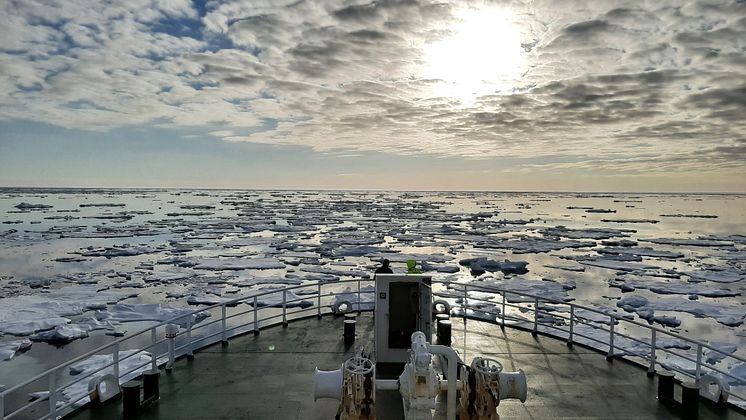
Pelagic Fish at the Barents Sea Polar Front in January 2024
Global Biodiversity Information Facility (GBIF) ()
Datasett
Kilder:OpenAlex, Nasjonalt vitenarkiv
4 Akvaplan-niva (nåværende ansatt)
Bidragsytere (6)
- Einat Sandbank
- Frida Anneke Cnossen
- Ingvild Ytterhus Utengen
- Maxime Geoffroy
- Conrad Helgeland
- Paul Eric Renaud
Abstract
Sampling Five pelagic trawl samples were collected with a Harstad pelagic trawl, which has an effective opening of 80 m2 when towed at ca. 3 knots. The mesh size of the inner liner of the cod end was 10 mm. The pelagic trawl was towed at ca. 3 knots for 20-30 min at the target depth and abundances were standardized by converting to catch per unit effort (expressed in kilograms per cubic meter).
Sample analysis All organisms were identified to the nearest species or genus onboard. Capelin had a large size distribution, so individuals similar in length were sorted into approximate size classes (small, medium, and large).
The total number and weight of each species was recorded. For large catches, subsamples of 20-30 individuals were taken as a representation of the length distributions of the catch.
The standard length, height at the anus (up to the nearest 1 mm), and weight (up to the nearest 0.1 g) were measured for all specimens caught and those in the subsample for abundant species.
Data management While the PolarFront project publishes all its data on Zenodo, biological diversity datasets are also published in the Global Biodiversity Information Facility (GBIF).
The data is prepared using the international Darwin Core (DwC) vocabulary (https://dwc.tdwg.org/) and is distributed as DwC text files that follows GBIF's data quality requirements and best practices for sampling event datasets.
Prior to publishing all data files are validated using GBIF's data validator (https://www.gbif.org/tools/data-validator).
Taxonomy is also validated against the GBIF API and World Register of Marine Species.